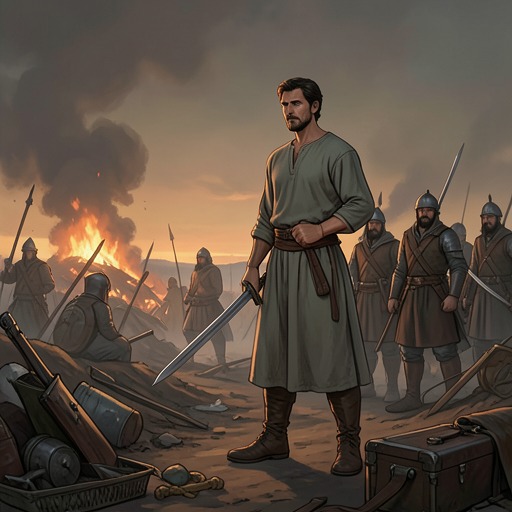
Wei's Campaign Against Shu
The Romance of the Three KingdomsThe Wei conquest of Shu was the campaign that ended Shu’s independence and brought the Han dynasty’s last ruling line to its close. Wei’s commanders exploited a court that ignored Jiang Wei’s warnings, overcame Shu’s defenses through coordinated advances and a mountain route, and pressed on to Chengdu. Though the narrative marks the surrender as the end of the Han, it also contrasts the political collapse with the effort to spare the people from further suffering.
Background and Strategic Opening
By the time the invasion took shape, Shu was weakened by disorder at court. Jiang Wei had withdrawn with eighty thousand men to Tazhong, where he planned to establish military colonies: soldiers would farm, train, and build supplies before a future campaign. The plan also took him away from the corrupt court. Wei’s leaders, Deng Ai and Sima Zhao, learned of the deployment through spies and judged that Shu’s disarray created an opportunity for a pre-emptive attack. They gave Zhong Hui command and agreed to disguise their intentions by pretending to prepare a campaign against Wu.
The invasion proceeded on more than one front. Deng Ai received orders to advance, while Zhong Hui moved against Hanzhong and another Wei force was sent against Jiang Wei at Tazhong. A dream of a spring erupting beneath his feet troubled Deng Ai; consulting the Yi Jing, he understood its prediction as promising success in the southwest and failure in the northeast. The portent accompanied the military advance, but it was the Wei armies’ coordinated pressure—and Shu’s failure to respond effectively—that changed the balance.
Jiang Wei recognized the danger and sent a memorial requesting additional help to defend the kingdom. Huang Hao intercepted it and misrepresented it to the Shu ruler as an effort by Jiang Wei to aggrandize himself. Huang Hao then arranged for a shaman to perform a divination at court. In a trance, she assured the ruler that Shu was at peace and would soon possess Wei’s lands. Taken in by the performance, the ruler allowed Huang Hao to ensure that Jiang Wei’s warnings were ignored. The court’s refusal to act left the kingdom exposed as Wei’s successes accumulated, including the capture of Hanzhong.
Advance Through Shu
Zhong Hui’s advance was accompanied by an episode that turned the campaign’s political meaning toward restraint. Near Dingjun Mountain, his troops heard unexplained sounds and saw phantom riders; Zhong Hui learned that the hill held Kong Ming’s tomb and made offerings there. That night, Kong Ming’s apparition urged him not to make the ordinary people of Shu suffer further when Wei conquered the western lands. Zhong Hui responded by having a banner made bearing the words “Protect the Kingdom; Reassure the People.” He ordered that civilians were not to be harmed, on pain of death. The people trusted him, and cities fell one after another without bloodshed.
Jiang Wei continued to retreat as Wei pressed forward. He escaped across a ford and took up a defensive position at Jian Pass, where additional Shu troops joined him. The pass offered a strong position, but it could not end the danger to Shu’s wider territory. Deng Ai chose to bypass the main defense by scaling the mountains. His troops’ unexpected route brought them to Jiangyou, which they took, opening a way deeper into Shu and threatening the capital from a direction the defenses had not prevented.
The advance also exposed divisions within Wei’s own command. Zhong Hui’s treatment of Zhuge Xu—whose attack on Jiang Wei had failed—alarmed Deng Ai, and the two commanders distrusted each other’s authority and plans. Their rivalry did not halt the invasion. As Wei forces continued forward and Shu positions fell, Jiang Wei was driven back toward Jian Pass while the threat to Chengdu sharpened.
Mianzhu and the Fall of the Capital
When news reached Chengdu that Deng Ai’s army had taken Jiangyou, Huang Hao again dismissed reports of danger as false, despite the ruler’s alarm. The shaman could not be found when the ruler asked to consult her again. Only then did the court turn to Zhuge Zhan, Kong Ming’s son, who had previously stayed away from government because of its corruption. Zhuge Zhan took command of the troops at Chengdu and initially checked Wei’s advance. In one encounter, the appearance of Kong Ming on his famous carriage unnerved Wei’s soldiers, and Shu forces inflicted heavy losses. Deng Ai then used a retreat-and-ambush strategy to defeat Zhuge Zhan’s army.
The defeated Shu forces fell back to Mianzhu. Zhuge Zhan sent to Wu for reinforcements, and Sun Xiu agreed to send them, but the preparations would take time. Not knowing whether help was on its way and seeing no immediate prospect of relief, Zhuge Zhan chose to make a final attempt to break out. He rode into battle with his son, Zhuge Shang. Both died, and Mianzhu fell the following day. Deng Ai, moved by their courage, gave father and son honorable burials. The road to Chengdu was now open.
The news of Mianzhu’s fall and the deaths of Zhuge Zhan and Zhuge Shang prompted panic in Chengdu. People began fleeing, anticipating a siege or occupation. At a council, officials debated escape to the south, refuge among the Man tribes, or an appeal to Wu. Qiao Zhou argued instead that surrender to Wei was the only practical choice: seeking shelter in Wu could merely lead to a second surrender if Wei later conquered it. He also maintained that surrender might allow the ruler to retain a territory and continue protecting the ancestral shrine and ordinary people. The ruler remained troubled, but Qiao Zhou’s memorial helped bring him to a decision.
Surrender and Aftermath
Envoys carried the surrender document and the seal of authority to Deng Ai’s camp. They were treated well and returned to Chengdu with news of the reception. The Shu ruler then instructed Jiang Wei to surrender as well. Liu Chen, the ruler’s son, could not accept the loss and rejected the decision, but the ruler ordered the surrender document prepared. Wei troops entered Chengdu in what the narrative describes as a triumph: relieved residents cheered and scattered flowers. The ruler was allowed to keep his palace, and the people were assured of good governance. Deng Ai also sent messengers to Chang’an to report the victory.
The conquest did not immediately resolve every danger within the victorious camp. Zhong Hui’s forces and Deng Ai’s army had advanced under separate commands, and their competition persisted as Wei took Shu. Huang Hao, whose deception had helped leave the kingdom unprepared, escaped by bribing those around him. These outcomes sit beside the orderly entry into Chengdu: the city’s surrender ended organized Shu resistance, but the fate of its people and officials still depended on the conduct of the new rulers and the rivalries among their commanders.
Political and Narrative Significance
The campaign completes the novel’s movement from the fragmentation of the Han into rival kingdoms to the destruction of one of those successor states. The three leaders associated with that division were Liu Bei, Cao Cao, and Sun Quan; the fall of Shu removes Liu Bei’s kingdom from the contest and brings the Han line in Shu to its end. The conclusion is therefore more than a military change of possession: it closes the political project of maintaining the Han through the Shu regime.
The conquest also tests the political claims made earlier in the story. Kong Ming had urged Liu Bei to oppose Cao Cao, whose control of the emperor gave his power an appearance of legitimacy, and later pressed Liu Bei to accept the imperial title as a means of continuing the Han line. In the invasion’s final phase, however, the court entrusted with that lineage fails to heed Jiang Wei, while the act that ends Shu is presented as a surrender made under overwhelming military pressure. The narrative links dynastic collapse not only to force in the field but to internal failure: a warning is intercepted, false reassurance replaces defense, and the capital turns to surrender after Mianzhu falls.
The novel’s treatment of Zhong Hui’s banner complicates the victor’s role without undoing the conquest. The apparition of Kong Ming leads Zhong Hui to promise protection for Shu’s ordinary people, and the cities’ bloodless submission gives that promise practical weight. Yet it is the Wei army that takes the territory, while Kong Ming’s final appearance serves the people of the kingdom he had once helped govern. The campaign thus ends with a double image: the Han line in Shu has perished, but its former strategist’s influence is invoked to protect those left behind.